
You Don't Have an AI Problem. You Have a Context Problem.
Why the firms that win the next decade won't own the most AI. They'll own the layer underneath it.
For two years you've been told a version of the same story: AI is coming for your industry, your margins, maybe your job. Adapt or be left behind. So you did the responsible thing. You bought the licences, your people started using ChatGPT, you ran a few pilots.
And almost nothing changed.
That's the anxiety most firms are sitting in. Not "AI is a hoax", the opposite. You believe it's real, you feel the pressure to move, and your own experience of it still falls flat. The gap between the fear you've been sold and the results you can actually point to is wide, and unsettling.
I sell AI for a living, and I'm a skeptic. In fact, everyone who works with AI should be a skeptic. Transformation has never come from a tool you bought or the cleverest model on the market. It comes the way it always has: from the unglamorous work underneath. Structuring your data and keeping it clean. Using the right tool for the right job and building on foundations instead of hype. In the age of AI, that foundation has a name. It's your context.
Context is everything that makes your firm yours: your clients and their histories, the deals you did, and the ones you passed on, and why. Your relationships, your judgement, the way decisions actually get made. Today it lives scattered across inboxes, spreadsheets, and people's heads. It's what you'd have to hand a sharp new employee before they could be any use to you, and it's exactly what an AI needs, too.
The models will keep getting cheaper and the agents more capable. Those you can rent. Your context is the one thing you should own. That's the only thing that compounds. And here's the part no one will say out loud: three players are fighting to own it. And you need to make sure you win.
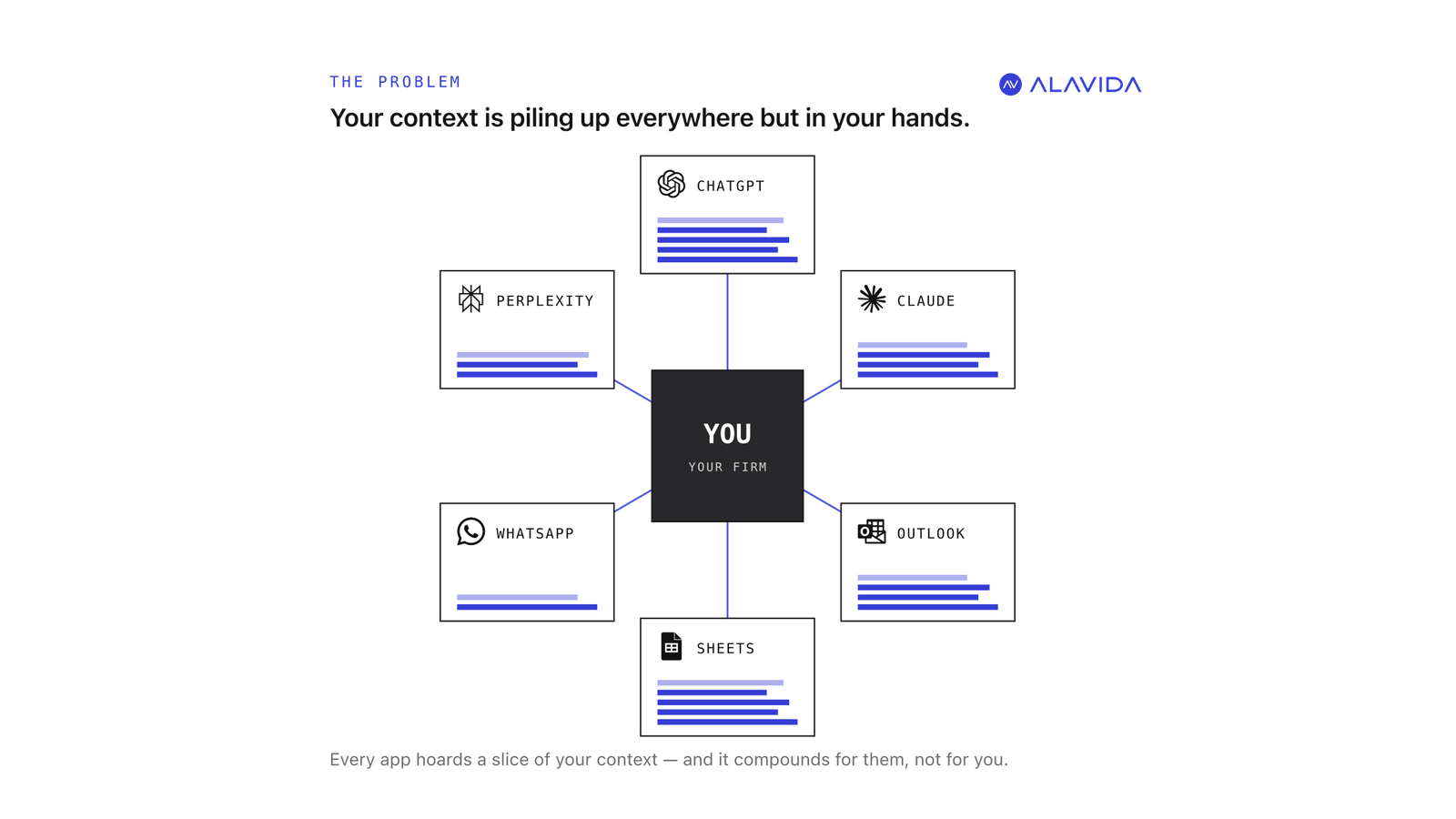
1. The labs need you to believe the model is everything, because the model is the part they can sell you, and your context is the part they want to take
The benchmark trick
Start with the propaganda, because you're swimming in it.
When a frontier lab unveils a new model, it shows you a chart where its bar towers over the rest, and often the axis doesn't start at zero, so a few points look like a generational leap. But the chart isn't the real sleight of hand. What the benchmark measures is.
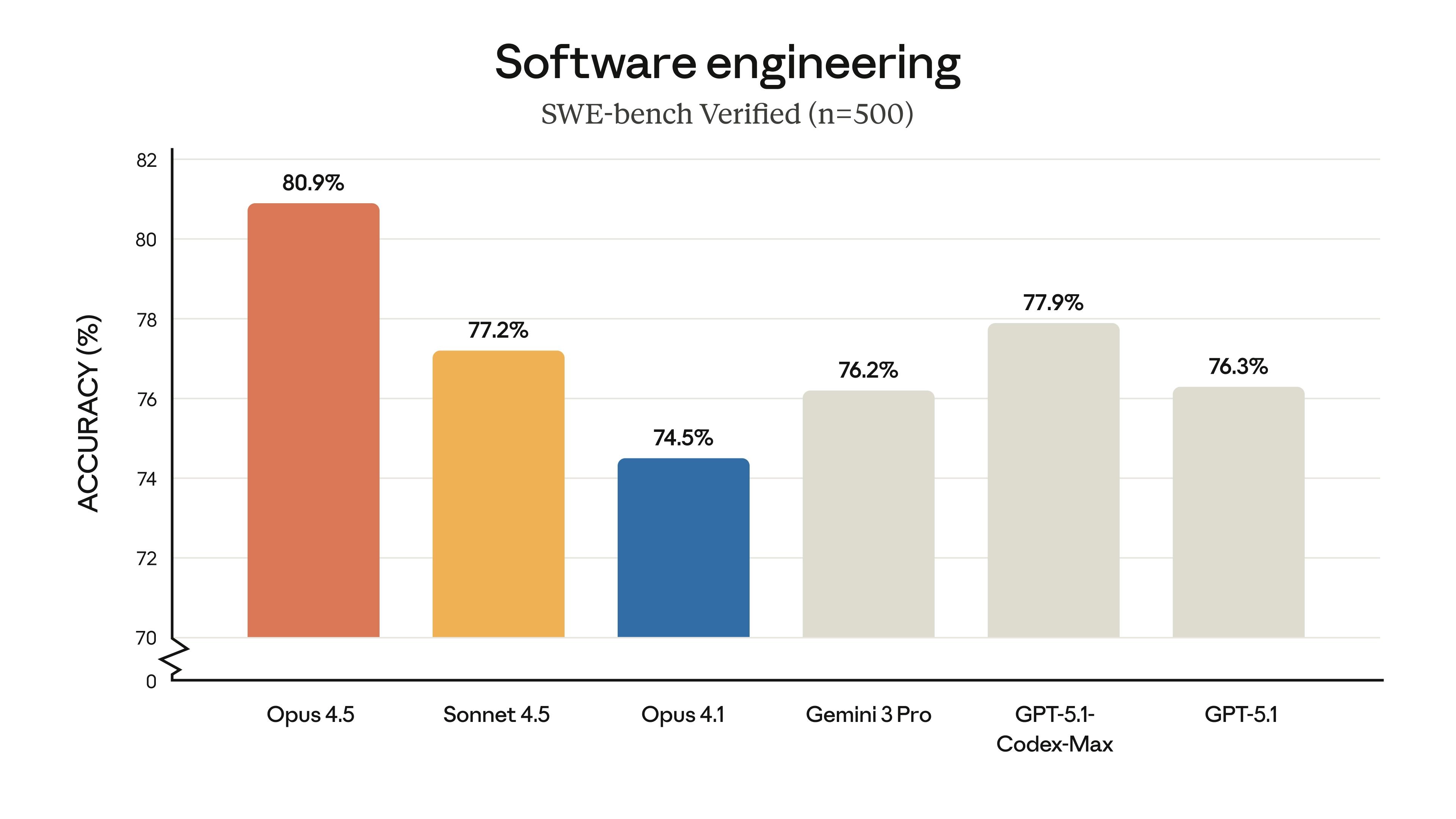
A benchmark hands the model a perfect world. The relevant context is already gathered, the data already connected, the question already framed. The model is graded purely on raw intelligence, inside an environment someone else painstakingly prepared. Your firm is the exact opposite: your context is scattered across inboxes, spreadsheets and heads. So the benchmark tells you almost nothing about what the model will do for you, because the hard part, the preparation, is the part you don't have yet.
A bubble and a revolution
So is it all hype? No, and this is where skepticism earns its keep. Think of the internet in 1999: a financial bubble and a genuine revolution at the same time. The people who lost their shirts weren't wrong that the web would reshape commerce; they were wrong about when. The hype crashed in eighteen months. The transformation took fifteen years, and it was total. The lesson isn't "wait." It's that the industry is structurally incentivised to overstate the next twelve months and understate the next ten years. There are valuations to defend and data-centre contracts to fill. You have more time than the marketing implies. What you don't have is a reason to let it stampede you into the wrong purchase.
The move to watch: into your context
And here's the move to watch, because it reveals where the value really sits. The labs know the model itself is becoming a commodity, cheaper and more interchangeable every quarter. So they're racing in the other direction: into your context. Every "memory" feature, every "the more you use it, the more it knows you," is the same play. Capture the one asset that compounds, make it expensive to leave, then price the intelligence accordingly once you can't. The model is the thing they sell you. Your context is the thing they're quietly trying to take.
2. The SaaS one-stop-shop is dead, and your software vendors are now fighting to be the place your context gets trapped
The bargain that quietly changed
The labs aren't the only ones reaching for your context. The software you already run is reaching for it too, and to see how, you have to notice that the deal SaaS offered you has quietly changed.
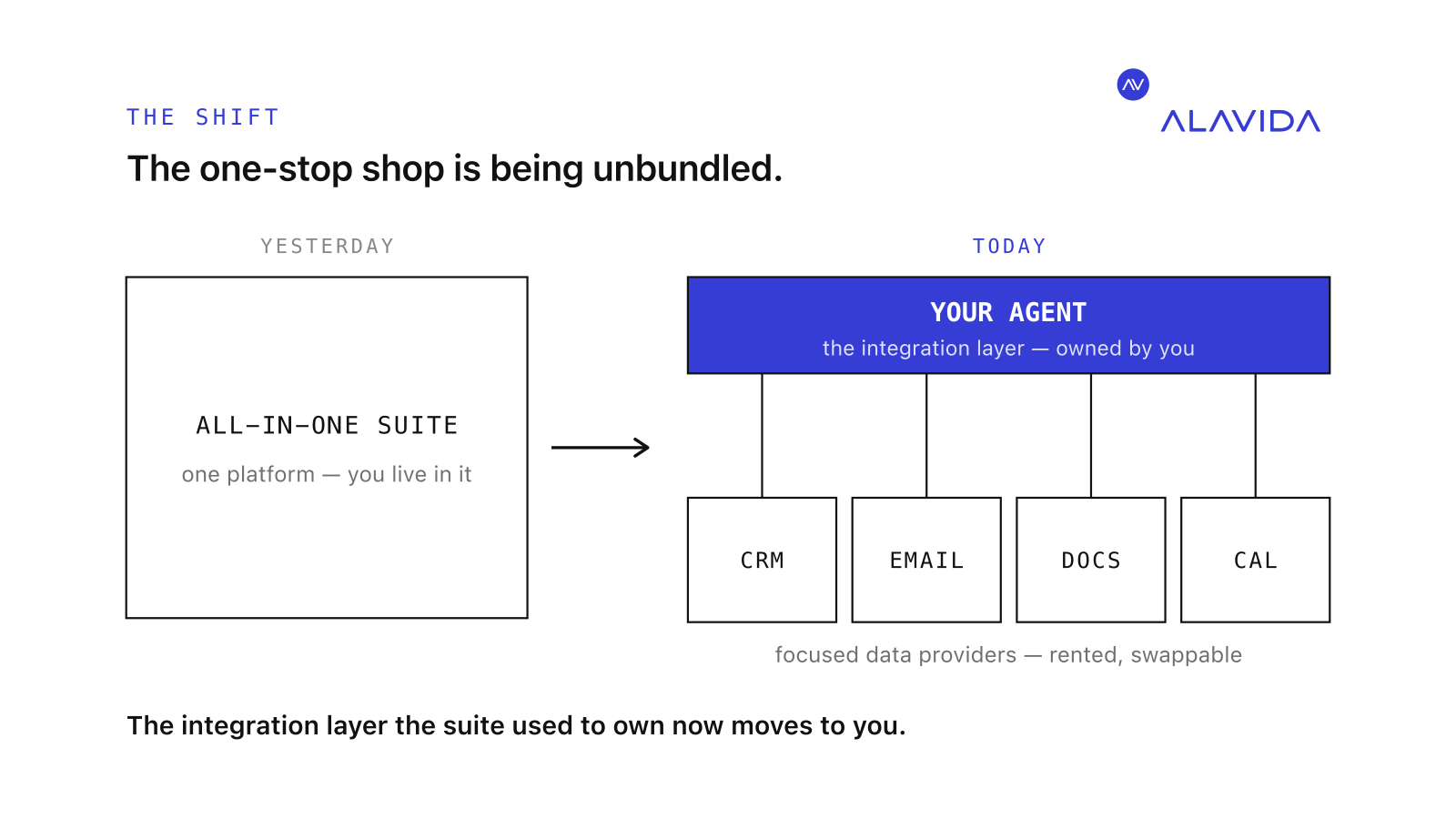
For two decades the bargain was clear. You handed a vertical platform all your data and workflows, and in return it was your one-stop shop, the single system for that job. That era is ending. Once agents become the thing that actually does the work, the vendor's incentive flips. It no longer wins by being where your people are happiest; it wins by being where your context and your agents can't leave. Watch what that produces: every product is now bolting an AI assistant onto its own data, each promising to be your AI, and each able to see only its own narrow slice of your business. The one-stop shop is being unbundled, and a quiet land grab for your context is taking its place.
A dozen blind assistants
The mistake is to let those built-in bots become your AI strategy by default. The CRM's assistant, the inbox's assistant, the document tool's assistant. Clever in their corners, blind everywhere else. Stitch your firm together out of a dozen walled assistants, and you haven't built an advantage. You've built a dozen new silos.
What “done right” looks like
The advisory firm I work with had already paid for this lesson. Their old CRM was a perfectly good product. It died anyway. The reason, in their own words: "the friction of usage was too high." It was a destination people had to log into and dutifully update, so they didn't. The last entry was from two years ago, and the knowledge that should have been in the system went into emails and people's heads instead. The fix wasn't a better CRM. It was giving the CRM a smaller, sharper job. They moved to Attio and positioned it deliberately, not as the place people live, but as a structured data provider: clean records for companies, people, client accounts and deals, built to be read and written by an agent through proper access patterns, not just clicked through by a human. The system now stays current as a by-product of the work itself, because no one has to feed it by hand.
So the question for every tool you own comes down to one thing: is it a data provider you can build on, or a cage with better marketing? Here's how to tell, before you sign.
But run the scorecard and you'll notice what even a perfect tool can't give you. The highest-scoring CRM still only knows what's in the CRM. Your context doesn't live in one product. It's spread across your CRM, your inbox, your calendar, your files. No vendor can sell you the thing that sits across all of them. That part you have to own yourself, and it's where we go next.
3. You're the only player who should own your context, then plug whatever agent you like into it
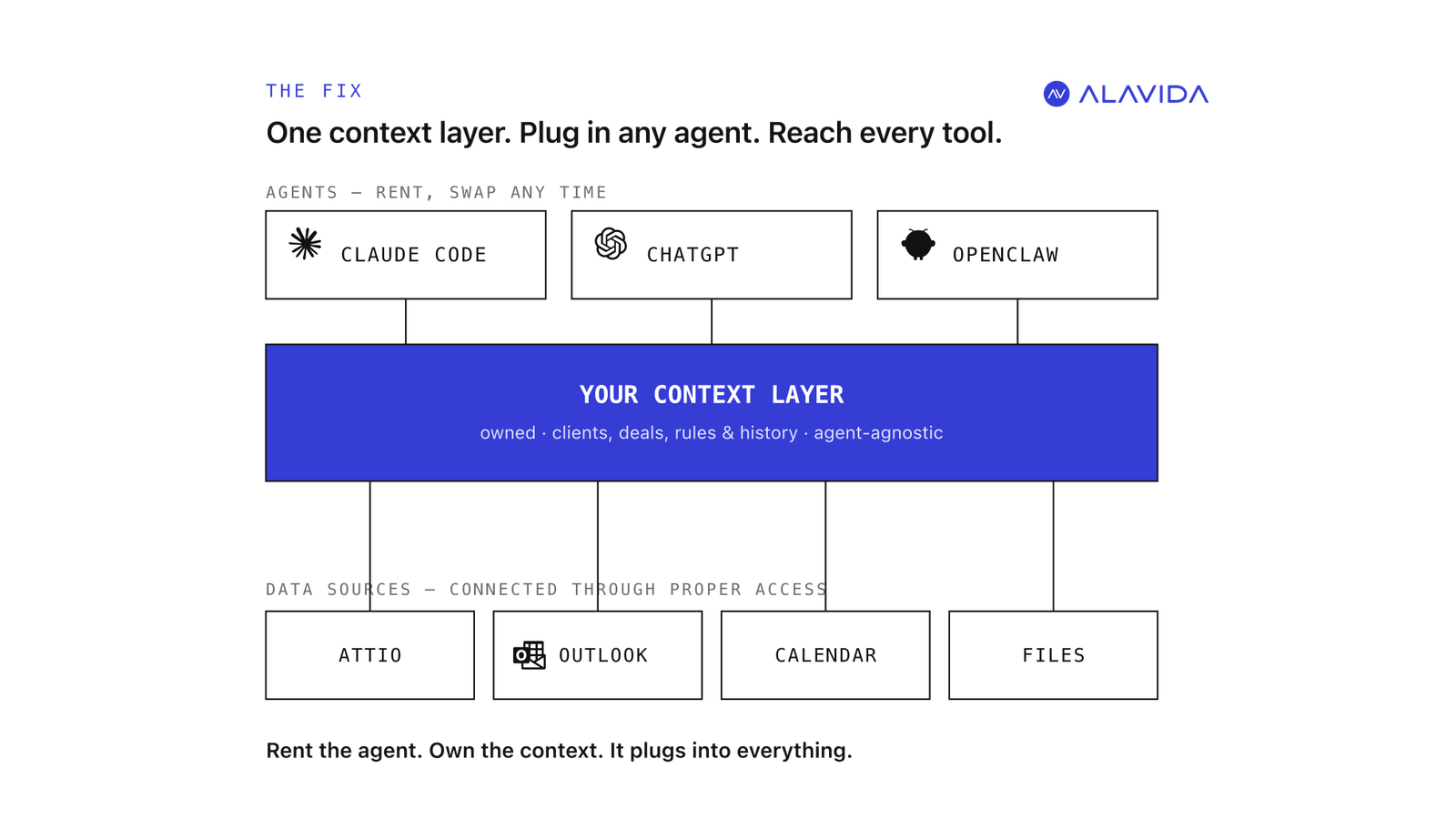
So if no single vendor can hold all your context, who does? You. Not by building some bespoke platform, but by owning the one thing that sits above all of them, your context, and treating every agent as something you plug into it.
You don't own the agent. You own what it plugs into
This is the part most people get wrong about "owning your agent." You don't build an agent. The agents are off-the-shelf and getting better every month. Claude Code, ChatGPT, OpenCLAW, Hermes. Like models, they're interchangeable, and you should treat them that way. What you own is the context they plug into: your clients, deals, rules and history, structured so that any agent can read it, write to it, and act on it across your tools. The agent is the worker you can swap out tomorrow. The context is the institution that stays.
Owned that way, an agent stops being a tenant in one vendor's building and starts walking the whole street. It reaches across your CRM, your inbox, your calendar and your files, because it's plugged into your context, not locked inside one product. And this pattern is what makes AI truly remarkable. Its ability to pull in context from your emails, Granola and your CRM in one fell swoop creating assets that would have taken days of coordination. Now done in minutes.
A Tuesday, with context
Here's what that looks like on a Tuesday. A relationship manager walks out of a client meeting; a family office has just shown interest in a private opportunity, call it a late-stage deal worth three to five million. In most firms that's the moment context evaporates: a little reaches the CRM days later, most of it never leaves the RM's head. And you don't fix that by asking him to do more admin. As the firm's own RM said, after a meeting you want feedback and engagement, not data entry.
So he sends a twenty-second voice note to an OpenCLAW agent on WhatsApp. By the time he reaches the lift, the agent has done the work. It logged the deal against the right opportunity and client in Attio. It checked Outlook and pulled the term sheet that had landed that morning. It drafted the follow-up for him to approve, then sent back a message: here's the record I created, here's the link, here's what I did, here are your next two steps. The note didn't just get filed. It did work for him.
Notice why that was possible. One agent reached across three vendors, CRM, email and calendar, because it was plugged into the firm's own context, not trapped inside any single product. That reach is the thing no vendor can sell you.
Front office speaks, the back office inherits
Now follow the note downstream, because this is where owned context compounds. An hour later an analyst in the middle office opens the same client's file. She doesn't chase the RM for his notes. The voice note already handed her agent the thread to pull. Work that used to wait days is already moving.
This is the part most firms get backwards. Front office and back office don't need the same agent. They need the same context in different shapes. The front office lives on the move, so it talks to an OpenCLAW agent on WhatsApp between meetings. The middle and back office work from a desk, so they run Claude Code or ChatGPT on a laptop over the very same context. Diligence, screening, analysis. Different agents, different surfaces, one shared context. And it only works in that order: without the front office's twenty seconds, the back office has nothing to work with. The firm named the old failure exactly: "we always miss out on certain nuances, a client says something that should have been picked up by another department, and nobody knew." Shared context is what closes that gap.
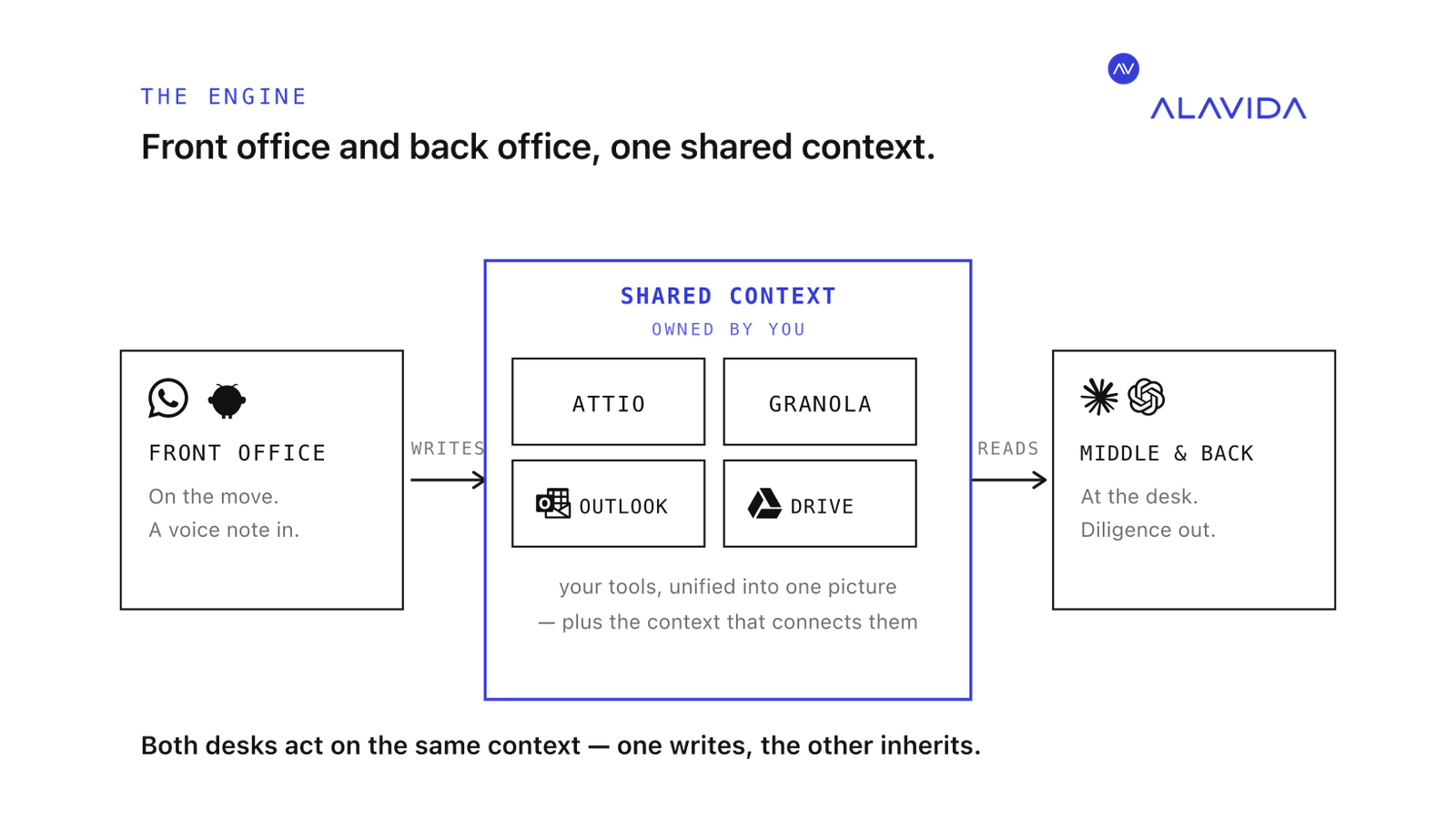
And because the context is yours and agent-agnostic, you're never married to any one of these tools. When a better agent ships next quarter, and it will, you point it at the same context and carry on. Swap Claude for ChatGPT, OpenCLAW for whatever comes next; nothing breaks, because the asset was never the agent. It's the same discipline as renting the model: use the best tool of the moment, own the thing underneath that compounds.
“Can I trust it?” Provenance
There's a question a serious firm always asks here, and rightly: can I trust what the agent tells me? You answer it with provenance. Every fact in your context links back to its source, so when the agent reports a client's risk rating or a position's exposure, it shows you where that came from and when. In controlled tests, pairing a model with a structured context layer roughly tripled its accuracy on real business questions, while the model alone scored zero on the hardest ones. Grounded in your own context, with its sources attached, AI stops being a confident stranger and becomes an auditable one.
It starts as a folder of text files
And if "own your context" sounds like an eighteen-month data project, all graph databases, a knowledge team and consultants in a war room, resist that. The foundation can start as plain text files in a shared repository: Markdown notes with a little structure, version-controlled in something like GitHub. A human and an agent read the same file. Every change is logged, so your audit trail is a by-product of the format. Nothing is trapped in a vendor's database. You can start on Monday, with one team and one client, and let it compound from there.
You already understand this instinct better than any technologist. You'd never let a single custodian hold every asset with no way to move it. Your context is your most important future asset. Don't hand it to a vendor on worse terms than you'd accept for cash. Rent the model. Rent the agent. Own the context. That is the whole strategy.
The firm that owns its context
Step back and the whole game is simple. Three players want the same prize. The context that makes your firm what it is. The AI labs are racing to capture it inside their models. Your software vendors are racing to trap it inside their platforms. Both are betting you'll stay distracted by the thing that's getting cheaper, the model, the tool, the demo, while they quietly accumulate the thing that compounds.
The firms that win the next decade won't be the ones with the biggest model budget or the most impressive tools. Those are rentable, and cheaper next year. They'll be the ones that did the unglamorous work, captured their context, structured it, kept it theirs, so that every agent they plug in, today's and next year's, starts with the full picture of the business. The firm whose institutional memory no longer walks out the door at 6pm or retires with a generation. The firm that rents intelligence by the month and owns its judgement for good.
You don't need to predict which model wins, or which agent, or which platform. That's the point. Own the layer underneath them and you can let them fight it out, swapping in whatever's best each quarter while your advantage compounds in the background.
So start now, while it's still unfashionable, one team, one client, a folder of files you control. Rent the model. Rent the agent. Own the context. That's the whole strategy.